Beyond the Story: Assert Your Value First in Behavioral PM Interviews
Discover ProductSimply's game-changing approach to behavioral and leadership questions: assert your core value upfront, then let your story be the undeniable evidence. Learn how to transform your interview responses into compelling arguments that showcase your unique fit for any top tech PM role.
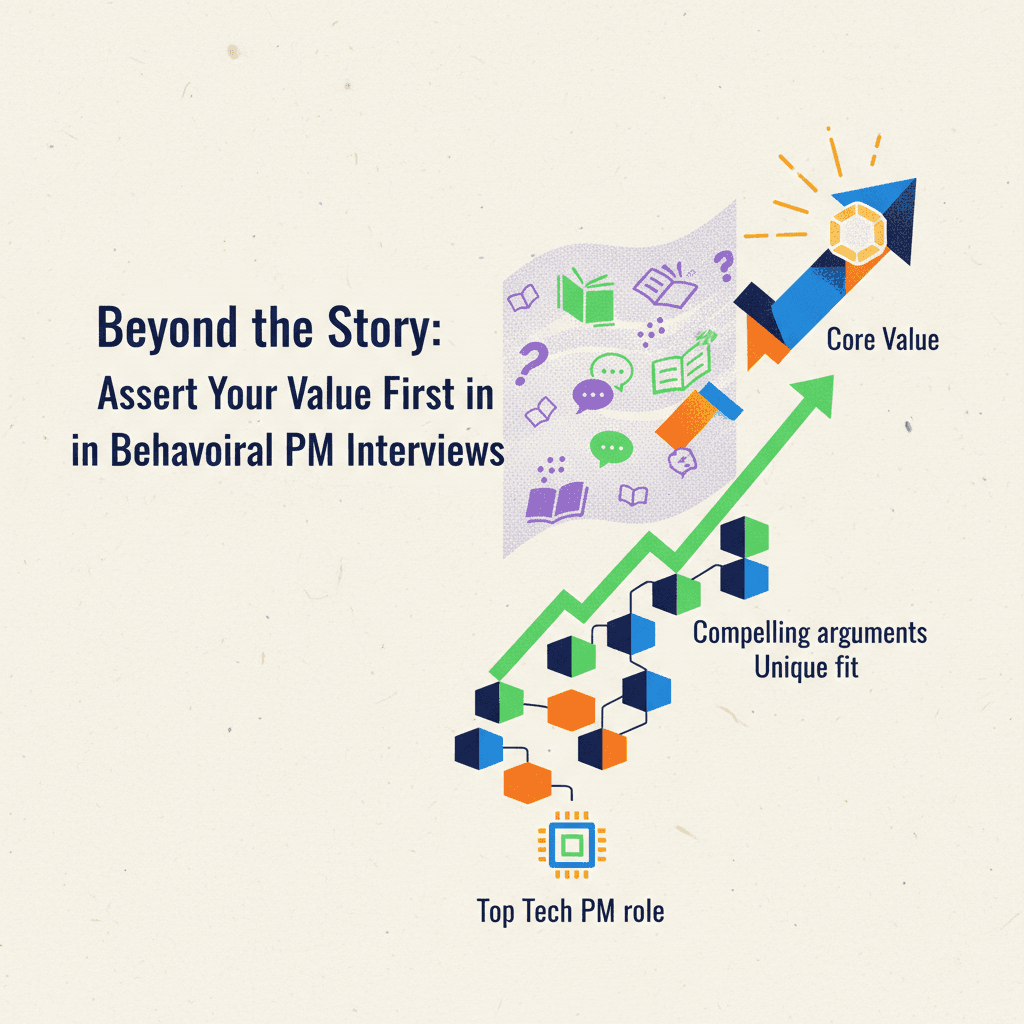
Beyond the Story: Assert Your Value First in Behavioral PM Interviews
In the high-stakes world of Product Management interviews, especially at top-tier companies like Meta, Google, and Amazon, every word counts. While technical and product sense questions test your hard skills, behavioral and leadership questions offer a unique window into who you are as a PM. They’re designed to uncover your motivations, your problem-solving style, and critically, your alignment with the company's culture and values. Yet, many talented candidates fall into a common trap: they tell a good story, but they don't make a compelling argument.
At ProductSimply.com, we believe that an interview is a performance, not just a test. It's your opportunity to "Run Your Show" – to confidently showcase the exceptional PM you already are. Our expert-led courses and 1-on-1 coaching have helped over 200 candidates land their dream roles, and a core tenet of our behavioral interview strategy is this: to answer a behavioral or leadership question, always focus on demonstrating in your story a specific value that you bring that is valuable to the target company. Assert that you have the value immediately in your answer, and let your story be the evidence.
This isn't just about sounding confident; it's about strategic communication. It's about ensuring your interviewer doesn't just hear a narrative but receives a crystal-clear signal of your worth. Let's dive into why this approach is so powerful and how you can master it.
The Pitfall of the Purely Narrative Approach
Imagine an interviewer asks, "Tell me about a time you faced a conflict at work and how you handled it." A common, well-intentioned response might immediately launch into a Situation, Task, Action, Result (STAR) framework:
- "Situation: In my last role, my team was struggling to meet a deadline because of a disagreement between engineering and design on a key UI element."
- "Task: My goal was to mediate and get the project back on track."
- "Action: I set up a meeting, listened to both sides, found a compromise by suggesting an A/B test…"
- "Result: We shipped on time, and the feature performed well."
While this follows a structured format, it leaves the interviewer to infer the core takeaway. What value did you demonstrate? Was it collaboration? Problem-solving? Strategic thinking? While a good story might hint at these, it doesn't explicitly state them. In a competitive interview, relying on inference is a risk you can't afford.
As our course content emphasizes, your goal in an interview is to "deliver a compelling argument...that you possess the communication skills, experience, values, attitude, and insight needed for the role." If you merely tell a story, you're hoping your interviewer connects the dots. When you assert your value upfront, you draw the dots for them.
The ProductSimply Way: Value-First Storytelling
Our approach flips the script. Instead of leading with the situation, you lead with the value. Your story then serves as undeniable evidence, making your argument clear, memorable, and impactful.
1. The Power of Immediate Assertion: "Incepting" Your Value
Think of your answer as a thesis statement. You want to "incept" a specific idea about yourself into the interviewer's mind. When you immediately assert the value you bring, you frame everything that follows. This is a critical component of maximizing "signal" – a core concept in ProductSimply's "Universal Rubric" for interview success, which emphasizes Substance, Structure, and Style.
- Substance: Your story provides the rich details.
- Structure: Asserting the value upfront gives your answer an undeniable, logical flow. The interviewer knows what to listen for, making it easier to follow and note-take.
- Style: Delivering a confident, value-led introduction projects a sense of control and intentionality, enhancing your overall presentation and making you more receptive to everything you say.
Consider the conflict example again, but with an immediate value assertion:
"I believe that effective conflict resolution hinges on fostering open communication and empathetic understanding, even when perspectives clash. This is a value I consistently bring to my teams. For instance, in my previous role…"
Now, the interviewer isn't just listening to a story; they're actively looking for evidence of "open communication" and "empathetic understanding." You've guided their interpretation, ensuring your message lands exactly as intended. This is about being authentic to your strengths and owning your expertise, as our "You're Great at This" lesson advises.
2. Identifying the Right Values for the Target Company
Asserting a value is only powerful if it's the right value – one that resonates with the target company and the specific role. This requires diligent research and strategic alignment, a process we demystify in our "Identifying Values" lesson.
How to Uncover Company Values:
- Company Careers Page: This is your goldmine. Search for "[Company Name] careers values" or "our principles." Companies explicitly state what they cherish in their employees.
- Job Description Keywords: Look for repeated adjectives or phrases in the job description. "Bias for action," "customer obsession," "thinking big," "earn trust," "move fast" – these are explicit clues to what they value.
- Interviewer Research: Look up your interviewers on LinkedIn. What do they emphasize in their roles or recommendations? This can offer subtle insights.
- Industry & Product Context: What does this company's product or industry demand? A startup might value "agility" and "resilience," while a mature platform might prioritize "scale" and "operational excellence."
Once you've identified these values, don't just parrot them. As our "Identifying Values" lesson suggests, look for keywords or phrases that provide deeper insights into what these values really mean to the company. For example, "innovation" might be explained further with "creativity," "disruptive thinking," or "pushing boundaries." Your goal is to not only embody these values but to speak their language.
Want to take the next step?
Work with MJ 1-on-1 for focused feedback, or keep preparing with the course and AI coach.
3. Crafting Your Evidence: The Story as Proof
With your value asserted, your story transforms from a mere recounting of events into a compelling piece of evidence. This is where the classic STAR (Situation, Task, Action, Result) or SAR (Situation, Action, Result) framework truly shines, reimagined through the lens of ProductSimply's storytelling principles:
Putting It All Together: A Step-by-Step Example
Let's walk through a complete example for a common behavioral question:
Question: "Tell me about a time you had to influence a skeptical stakeholder without direct authority."
Company Value to Emphasize: "Bias for Action" combined with "Earn Trust."
1. Assert Your Value (The Premise): "I believe in demonstrating a strong bias for action, especially when faced with ambiguity, and this often requires proactively building trust to influence stakeholders without direct authority. My approach is to lead with data and a clear vision of the impact. I recall a situation at my previous company where I needed to advocate for a significant shift in our product strategy."
2. Set the Stage with Stakes and Scope (Situation): "As a Senior PM for our core monetization platform, I identified a significant opportunity to pivot our advertising product towards a new, high-growth vertical that could unlock an additional $20M in ARR over two years. However, our Head of Sales, a veteran with immense influence and a preference for established revenue streams, was highly skeptical. He believed focusing on existing clients was less risky, and his team's buy-in was crucial for any new sales motion. The stakes were high: failing to act meant missing a critical market window, while pushing too hard risked alienating a key executive whose support was indispensable."
3. Detail Your Actions (Action): "Recognizing the need to earn his trust and address his concerns head-on, I didn't just present a slide deck. First, I conducted extensive market research and competitive analysis, validating the market potential and identifying specific pain points of customers in this new vertical. I then partnered with a mid-level sales manager (a trusted ally) to run a small, low-risk pilot program with a few willing clients, gathering early proof points and direct customer feedback. I compiled this data into a concise, actionable report, focusing on the pilot’s successes and outlining a clear, phased rollout plan that mitigated his perceived risks. I scheduled a dedicated one-on-one session with him, where I presented the data first, listened intently to his objections, and addressed each with specific, data-backed counter-arguments and adjustments to the plan. I emphasized how this new vertical would eventually enhance, not detract from, his team's long-term success."
4. Quantify Results & Reiterate Value (Result): "The Head of Sales, convinced by the pilot's success and the thoroughness of my approach, not only approved the pivot but became an active champion, allocating resources from his team to support the new vertical. Within six months, we exceeded our initial revenue projections for the new product by 15%, adding $5M in ARR, and successfully expanded into two new sub-segments. This experience reinforced my belief that a bias for action, coupled with meticulous preparation and a commitment to earning trust through data and empathy, is the most effective way to drive strategic change, even without direct authority."
Preparation & Practice for Mastery
Mastering this value-first approach requires thoughtful preparation and consistent practice. Our ProductSimply platform offers comprehensive resources to help you excel:
- Build Your Story Inventory: As highlighted in our "Your Story Inventory" lesson, document your key career moments – successes, failures, conflicts, leadership experiences. For each, identify the values you demonstrated. This acts as a mental cheat sheet, allowing you to quickly select the most relevant story for any question.
- Research Company Values Thoroughly: Before every interview, revisit the company's career site and job description. List out 3-5 core values and brainstorm how your stories align. This is a crucial step detailed in our "Cheat Sheets" lesson.
- Practice with Purpose: "Practice Behavioral Interviews Without Notes" and "Always Practice in Front of Someone (or Something)" are key recommendations from our "Preparation Overview" lesson. Record yourself, listen back, and ask: Did I assert my value clearly? Did my story provide compelling evidence? Was my message received?
- Seek Expert Feedback: ProductSimply's 1-on-1 coaching sessions provide tailored feedback on your behavioral responses, helping you refine your value assertions, storytelling, and overall delivery to make sure you're maximizing your signal.
Conclusion: Make Your Argument Unforgettable
In the competitive landscape of PM interviews, it's not enough to have great experiences; you need to articulate their value with precision and impact. By adopting ProductSimply's value-first approach to behavioral and leadership questions – asserting your core value immediately and letting your story serve as undeniable evidence – you transform your responses into powerful, memorable arguments.
This strategy ensures your interviewer understands not just what you did, but why it mattered, what values drove you, and how those values align perfectly with the company's needs. It's about taking control of the narrative and confidently demonstrating that you are the Product Manager they've been searching for. Start practicing today, and make every answer count.
Written by

Former Meta Senior PM. #1 rated PM interview coach on IGotAnOffer with 538+ clients and a 49% rebook rate.
Want to take the next step?
Work with MJ 1-on-1 for focused feedback, or keep preparing with the course and AI coach.
Related Articles

Ultimate Answers: Tell me about a time when you had to rally a team
Rallying a team is more than just motivational speeches; it's about deeply understanding what's holding them back and strategically providing the support they need. This crucial PM interview question tests your diagnostic skills and empathetic leadership, not just your ability to inspire.
February 28, 2026
North Star Metrics: Why Averages Fall Short and Totals Lead the Way
A North Star Metric (NSM) should always reflect growth, pushing your product "up and to the right." Discover why static averages fail as guiding lights and how to leverage them as critical countermetrics to ensure quality alongside quantity.
February 16, 2026
Product School vs. Product Simply: Which is Right for Your PM Interview Prep?
Navigating the crowded landscape of Product Management interview prep can be daunting. This article breaks down two popular options, Product School and Product Simply, to help you decide which platform best aligns with your career goals and interview preparation needs.
February 15, 2026