Why Preparing for a PM Interview Can Make You a Better Product Manager
A good PM interview makes your product judgment visible. Preparing well can sharpen the same reasoning and communication you use on the job.
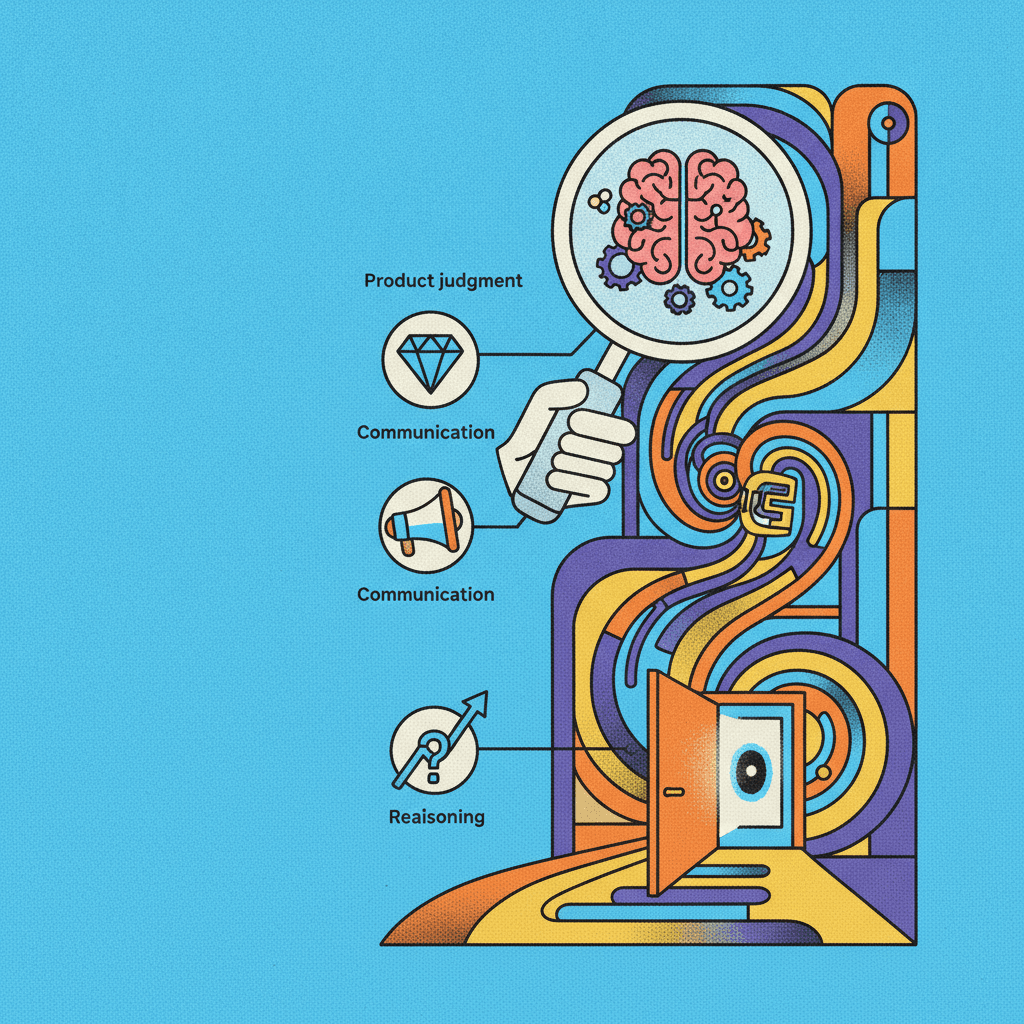
A useful way to describe product management is that the job keeps returning to the same question:
What should we do next, and why?
Answering it well requires understanding the situation well enough to make a choice, explaining the reasoning behind that choice, seeing what happens, and updating your understanding. The circumstances change constantly, but that basic act of judgment appears everywhere in product work.
This is also what a good PM interview asks you to demonstrate.
The interview strips away much of the machinery of the actual job. There is no team working beside you, no week of research, and no opportunity to let organizational momentum carry a decision forward. You are given an unfamiliar situation and asked to reason your way through it in real time. More importantly, you have to make enough of that reasoning visible for someone else to understand why your choices make sense.
That makes the interview artificial, but it also makes it unusually useful as a practice environment.
The interview makes your reasoning visible
At work, it is possible to make good decisions without being able to reconstruct precisely why they were good.
Experience gives you intuition. Familiarity with the product eliminates possibilities before you consciously consider them. Conversations with customers and colleagues gradually shape your understanding. Existing strategy gives you boundaries. Sometimes the right direction becomes apparent through dozens of small interactions rather than one explicit moment of reasoning.
An interview removes most of that accumulated context.
If you decide to focus on one customer instead of another, the interviewer can ask why. If you identify one problem as more important, you need some basis for believing it. If you recommend a solution, you have to connect it to the problem you just described. If new information changes the situation, the interviewer gets to see whether you reconsider the decision or defend it reflexively.
The constraint forces reasoning that might otherwise remain implicit to become explicit.
That is useful because making a decision explainable is one way of testing whether you actually understand it. A choice that feels obvious can become much less obvious when somebody asks what evidence supports it, what you are trading away, or what would cause you to change your mind.
The interview creates more of those moments in thirty minutes than an ordinary week of product work might produce so cleanly.
Good preparation therefore focuses on judgment
This is where interview preparation can either become valuable practice or become detached from the job.
You can prepare by memorizing the expected sequence of an answer and learning how to reproduce it reliably. That may improve your interview performance to some degree, but the learning is tightly coupled to the interview format.
The more transferable approach is to understand why the pieces of a strong answer exist.
Segmentation matters when meaningful differences between customers should change your decision. Prioritization matters because choosing one thing means accepting that something else will receive less attention. Metrics matter because you need evidence that the change you made produced the outcome you intended. None of those ideas depends on an interviewer asking for them.
Want to take the next step?
Work with MJ 1-on-1 for focused feedback, or keep preparing with the course and AI coach.
Understanding the reason behind a step also tells you when the step is unnecessary. If the customer is already obvious, there is little value in performing a segmentation exercise for its own sake. If the objective is genuinely ambiguous, moving directly to solutions creates a different problem. The structure of the answer should follow the reasoning the situation requires.
This is the same flexibility good product managers need at work. The process is useful because it helps you think, not because faithfully executing the process produces the answer.
Interviews are also practice in communicating judgment
Product decisions usually emerge from far more information than anyone wants to hear in the final explanation.
A PM may have spoken with customers, worked through technical constraints, changed assumptions, considered several alternatives, and had multiple disagreements before arriving at a recommendation. The eventual audience still needs a comprehensible answer to a much smaller question: what should we do, and why?
Interviews make that compression unavoidable.
You have enough time to establish the important facts and reasoning, but not enough time to narrate everything that contributed to your understanding. You have to decide what the listener actually needs in order to follow the argument.
That becomes particularly difficult as PMs become more experienced. More experience usually means more context is available, and therefore more judgment is required about what to leave out. A senior candidate can easily make an answer harder to understand by supplying every relevant organizational detail instead of selecting the few that explain the decision.
Learning to preserve the reasoning while removing unnecessary context is useful far beyond interviewing. Product managers do it in reviews, strategy discussions, roadmap decisions, executive communication, and ordinary conversations with their teams.
The transfer is real, but bounded
An interview can only expose a portion of what makes someone a good product manager.
It cannot reproduce the trust built through repeated interactions with a team. It provides a weak test of whether someone will execute reliably for months after a decision is made. It cannot recreate the amount of information available in a real product environment or show how someone behaves after living with the consequences of a series of choices.
So strong interviewing is not evidence of complete PM ability, and interview practice is not a substitute for doing the job.
The narrower claim is more useful anyway: many PM interviews deliberately create situations in which product judgment has to become observable. When preparation improves the underlying judgment rather than teaching a performance around it, some of that learning should transfer.
You get repeated opportunities to make a decision, explain why, encounter a challenge, notice where the reasoning is weak, and try again.
That is deliberate practice on a meaningful part of the job.
The immediate reason to prepare may be an interview. But if the practice leaves you more capable of answering what should we do next, and why?, the interview was not the only thing you were preparing for.
Written by

Former Meta Senior PM. #1 rated PM interview coach on IGotAnOffer with 538+ clients and a 49% rebook rate.
Want to take the next step?
Work with MJ 1-on-1 for focused feedback, or keep preparing with the course and AI coach.