Should You Use Refactoring UI to Prepare for PM Interviews?
Often seen as a resource for developers and designers, Refactoring UI offers invaluable insights for Product Managers preparing for interviews. Learn how understanding UI principles can sharpen your product sense, communication, and empathetic thinking, making you a more effective and impressive candidate.
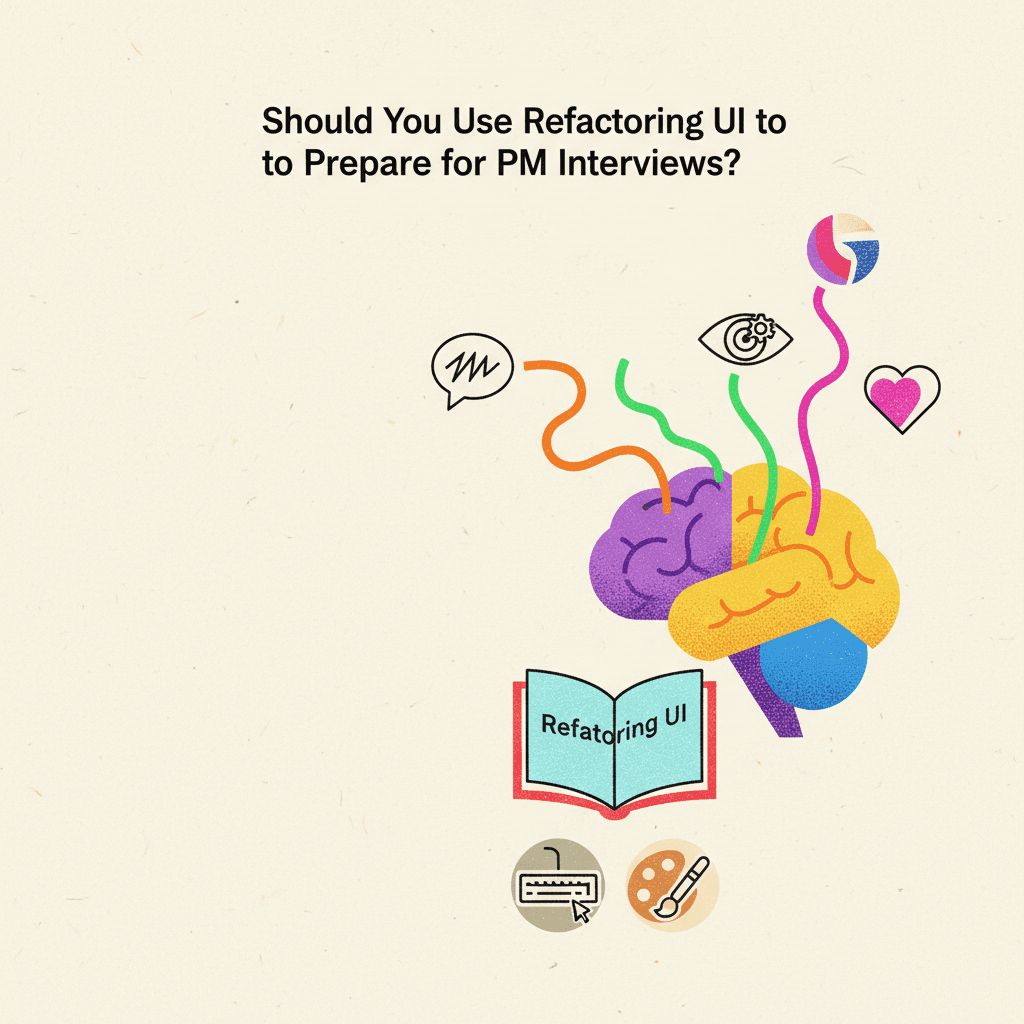
In a Product Management interview, Product Sense is often the difference between a "hire" and a "pass." But most candidates treat "design" as an intuitive magic trick performed by their colleagues in Figma. If you want to stand out, you need to stop treating UI as aesthetics and start treating it as information hierarchy. This is why Refactoring UI by Adam Wathan and Steve Schoger is a secret weapon for PM interview prep. It’s not a book about making things "pretty"—it’s a masterclass in making things obvious.
1. Moving from “Vague Feelings” to “Design Logic”
The biggest mistake PMs make in interviews is using subjective language.
- The "General" Approach: "I think the layout should be cleaner and more modern."
- The Refactored PM: "We need to increase the white space and use a de-emphasized secondary button style to reduce the cognitive load on the primary CTA." Refactoring UI teaches you the why behind the what. When you can explain that a screen feels cluttered because it lacks a clear visual hierarchy (using font weight and color instead of just size), you demonstrate a level of technical depth that most PMs lack.
2. Winning the Product Sense Round
In a Product Sense interview, you’re often asked to wireframe a solution on a whiteboard. If your wireframe is just a series of boxes, you’re missing an opportunity to show empathy for the user. By applying principles from Refactoring UI, you can:
- Establish Hierarchy: Immediately identify the "Primary Action" versus secondary noise.
- Solve for Edge Cases: Understand how to handle "Empty States" or "Error Handling" so they feel like features, not afterthoughts.
- Simplify Complex Data: Use tactics like "labeling values, not just rows" to make data-heavy dashboards intuitive.
3. Building Instant Credibility with Designers
Product Management is the art of influence without authority. Your most important partnership is with your Lead Designer. During the "Cross-functional Collaboration" portion of an interview, mentioning that you study design systems like Refactoring UI signals two things:
- You speak the language: You won't ask for "bigger logos"; you'll discuss "consistent spacing scales" and "visual weight."
- You respect the craft: You’ve invested time to meet designers on their turf, which builds immediate trust and speeds up the development cycle.
4. The “Minimum Viable Design” Mindset
In a startup or lean product environment, you don’t always have a designer for every small experiment. A PM who can build a "high-fidelity" mockup that doesn't look like amateur work is 10x more valuable. It allows you to ship faster, test hypotheses with higher confidence, and present ideas to stakeholders that look like finished products rather than sketches.
The Bottom Line
Studying Refactoring UI isn't about learning how to use Photoshop. It’s about sharpening your taste. In an interview, "taste" is just another word for "predicting what will work for the user." If you can articulate why a design works using the logic of hierarchy, contrast, and spacing, you aren't just a PM who "gets" design—you're a PM who can lead it.
Written by

Former Meta Senior PM. #1 rated PM interview coach on IGotAnOffer with 538+ clients and a 49% rebook rate.
Want to take the next step?
Work with MJ 1-on-1 for focused feedback, or keep preparing with the course and AI coach.
Related Articles

The Hidden Heart of Product Design Interviews: It's All About Empathy
Many candidates approach product design interviews as problem-solving tests, but the true differentiator lies in demonstrating genuine empathy. Discover why understanding people's needs is the core skill interviewers are seeking, and how to showcase it.
February 15, 2026
Beyond Features: Why Strategic Insight is Your Senior PM Interview Superpower
For aspiring Senior and Principal Product Managers, simply outlining features in a product sense interview isn't enough. Learn why demonstrating deep strategic insight into competitors, company strengths, and industry trends is crucial for landing higher-level PM roles.
January 11, 2026
Avoid Non-Solutions: 6 Ways to Define Relevant Product Sense Solutions
During product design interviews, it's crucial to propose solutions that genuinely address specific user problems. Many candidates fall into the trap of suggesting "non-solutions" — responses that appear valid but don’t truly resolve the core issues users face. These superficial solutions may seem attractive initially but lack effectiveness and relevance, reflecting a shallow understanding of user needs.
December 18, 2025